This topic is here, since it's a thing people are concerned about, not just for a pandemic, but in general, since I did a general post way back when.
But for another whack at it, read on.
First off, you need a water source. Canteen, jug, well, cistern, pond, lake/river/stream, stored rainwater, snowmelt, whatever.
Second, you need a minimum of a gallon/person/day, just for drinking and cooking for survival. With heavy work (like filling sandbags) in hot weather that can climb to 3-5 gallons/person/day. A co-worker did a reserve activation to Iraq when the range was live in both directions, and part of that was acclimating in a camp in Saudi Arabia/Kuwait (I forget which, doesn't matter). The point was, in 120-degree weather, he described drinking so much water daily to keep up with physiological requirements his throat hurt from all the swallowing. He was a Navy corpsman, and what he really wanted to do was to stick two large-bore IVs in his elbows and hang saline bags wide open, as opposed to waking up at 3 AM feeling like a dry sponge, and pounding out cramps in his thigh muscles from electrolyte losses. Water is a big deal, and a gallon a day is just a guideline. Adjust as necessary.
Third, at some point, having enough to wash your hands and face, shower all over occasionally, and wash clothes is going to become not just a convenience, but a health issue. Mentally make some plans there too.
Once you've figured out where you'll get it, you need to make it clean.
Some options to consider:
A. Solar distillation
In a survival situation, you can always try a solar still:
It works, but.
In a desert survival situation, dig them at night. Doing so in the daytime will cost you more in sweat than you'll get back in drinking water. And you'll need more than one, because they don't get you much. You'd also want to make provision to recycle your urine output, and let the sun turn it back into just water. (Hey, it worked for the astronauts.)
But where this technique is better suited is purpose-built fixed solar stills.
That assumes you have the raw materials to make one. Or ten.
Wooden box, angled glass top, water pan inside, and drain tube to a 5 gallon bottle. Just remember that the germs you're filtering out now live inside the beginning pan. Clean it with a bleach solution from time to time. But if you had germ-filled water in abundance, and even a moderately sunny day, a few of those would keep you in water indefinitely, and you could build as many as you needed for your family/tribe.
B. SODIS
SODIS stands for solar disinfection. Simply put: load up a clear 1-liter water bottle. Put it in the sun all day. Tomorrow, it's drinkable.
You'll need two days worth of bottles, minimum. (one to drink from today, and one to be sunning for tomorrow's consumption). And sunny days, and warm weather. This won't work in Alaska in winter. For about 80% of the earth's surface, on sunny days, it will. But it requires the ability to leave your water out all day (6 hours minimum kills most everything) unattended. It's become the norm in most of the third world where clean drinking water doesn't exist. It's one of those tree-hugging Peace Corps ideas that works, as long as the sun and plastic bottles hold out.
Nota bene that a 1-liter, maybe 2-, is about the most this will work for. Larger thicknesses mitigate the sun's UV (which is what kills the nasties) too much to work 100%, and you'll get sick. It also doesn't work with tinted/colored bottles, for the same reason.
C. Chemical disinfection
1) Clorox or generic bleach (sodium hypochlorite) is fine. What you want is standard 6.025% plain-jane, unscented, no additives or other foofery, household bleach. 2 drops quart/8 drops per gallon (get an eyedropper!) for clear water, double that for cloudy water, and/or when it's cold (say below 50F) outside. Put it in, swirl/slosh it around, wait 30 minutes, and you have drinking water.
But household bleach has a shelf life. For 6 months, it's fine. But it loses 20% effectiveness after a year. (So add 20% more bleach if you're using a year-old jug). At five years, it's not bleach; it's just water. (Really nasty undrinkable water, BTW.) But the important point is, it isn't bleach either.
If you want a fresh batch, mix your own. Get Pool Shock. read the label, and make sure you're getting the mixture that contains only sodium hypochlorite. Nothing else.
Then do the math to make yourself a fresh batch of 6% by mixing that amount in the proper proportion of water. Now you've got a new bleach batch. (It's basic chemistry. Look it up yourself, and get it right. If you can't figure out how, you shouldn't be playing with it.)
Ready or home-made, light and heat speeds its decay. Store it in a cool, dark place in a lightproof bottle. If you're mixing your own, do it in small batches, and write the mix date on the bottle. If in doubt, pitch it out, and mix a fresh batch. And date it.
Bleach, and Pool Shock, are both corrosive. Store them in original containers, away from other items. Pool Shock will corrode metal containers left nearby or in contact. So storing
a bag of it in a heavy plastic tote, all by itself, in a brick or concrete bin inside, all by itself, would be a lot smarter that putting it in a metal locker in the sun with a loot of other things.
Ignore this at your own peril.
2) Potassium permagnate (KMnO4) is another chemical that will work, and is recommended in truly splendid survival manuals like Lofty Wiseman's SAS Survival Handbook. (The book is the real deal, and you should get a copy.) It's stocked as a water filtration chemical at places like Lowe's. In weak doses, it'll purify water. Stronger solutions can be used to clean wounds. And it can also be used as an expedient survival firestarter in combination with glycerin (a fact known to both arsonists, and arson detectives). It requires careful storage, and due diligence in handling and use.
3) Iodine crystals
If you aren't allergic to iodine (or shellfish, which usually indicates an iodine allergy),
The Polar Pure water disinfection solution is the best $20 you'll ever spend. Inside the bottle are iodine crystals. You pour water (clean, dirty, doesn't matter) into the Polar Pure. This makes an iodine solution. You pour that into the appropriate 1-quart/liter-sized container, wait the specified time, and presto!, the water is chemically disinfected. Germs are dead. The crystals stay inside the mix bottle; only enough iodine leaches into the water to do what you need each time. You can use the thing for 2000 times, 500 gallons worth, over 1 1/2 years for one gallon/person/day. Simple, bomb-proof, effective. The bottle is the size of a Tylenol bottle. The crystals sit there just fine, with a shelf life of functionally indefinitely.
D) Mechanical filtration
or any similar ones, you simply pump the dodgy water through an extremely fine (0.2 micron, for the Katadyn one) ceramic filter; crap in, pure H2O out. Check filter size, and usable life. I'm partial to the Katadyn because 0.2 microns gets everything, bacteria, viruses, and cysts like giardia, and also because it lasts for 50,000 liters/13,000 gallons. If it gets clogged, you unscrew the filter element, wash it off in clean water, and scrub it with the provided brush, and it's back in action. It's pricier than others, but it works, and lasts a lot longer. When you get quality gear, buy once, cry once is the rule. Filters like this are great because if there's water, albeit non-potable, you only need to carry the filter to make more; it takes a couple of minutes to fill a water bottle/canteen.
Smaller, less robust/long-lasting solution also work, all the way down to Lifestraw type of filters.
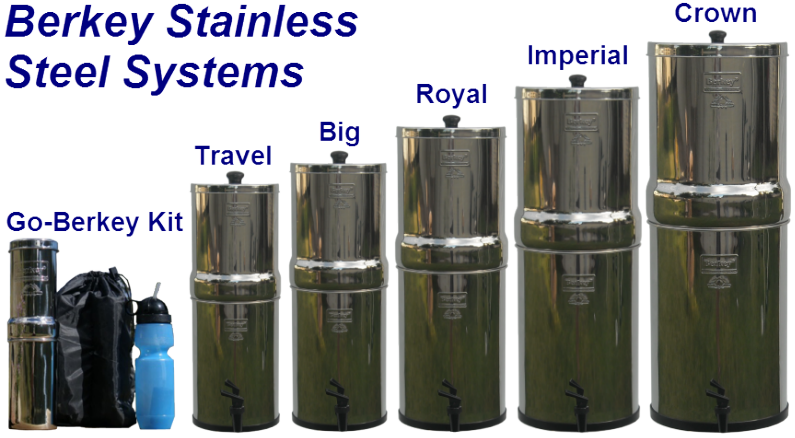
the way to go. Depending on the size, they work with between 2 and up to 8 filter elements, and will do 2.5-6 gallons at a go. Pour dirty water in the top tank, it percolates to the clean holding tank at the bottom. Avoid their plastic models (they have issues); the stainless ones are just the thing for a home or base camp set up.
Both the Katadyn and Berkey line filter elements are replaceable, so getting spare elements is like having a spare tire or two for the car - gets you back in action for less than the price of an entire second car.
There are other brands as well, or you can home-make some from a food-grade bucket and ceramic filter elements, and they all do the same sort of job.
E) UV inactivation
The same thing SODIS uses the sun for, you can use UV light for. You can get fancy dedicated home set-ups (better know what you're doing, and know a water treatment UV expert to set you up). For smaller quantities on the go, there's nothing handier than the Steri-Pen UV water purifier.

Stick it in a liter/quart of water, turn it on, wait 90 seconds, and the critters you're worried about have been sterilized. Which means that they can't reproduce in you, so you don't get Traveler's Curse, AKA the Tijuana Two-Step (because you've got two steps to get to the commode). A set of lithium batteries will do 100 liters (25 gallons). You can replace the batteries, and use the bulb for 3000 liters (750 gallons). They sell other models, with more or fewer doodads and accessories, but they all work the same way. This is the same thing that SODIS does with sunlight, but in a minute and a half instead of 6 hours, and the sun is free, whereas the Steri-Pen goes for $40-80 bucks, and works at night, in a cave underground, as long as your batteries hold out and you don't break it.
F) Boiling
Q.: How do nuns make holy water?
A.: They boil the hell out of it.
Q.: How do you make drinking water out of dirty water?
A.: The same recipe.
The same thing works to kill the critters in any questionable water.
I mention it last, because it's time and fuel intensive. But it works every time.
Water in pot, pot on heat source, boil water, let cool, pour back and forth to replace dissolved O2 so it doesn't taste flat, drink. You've now passed Day One of Home Economics, and are smarter than all doctors before Louis Pasteur's Germ Theory became well-accepted.
Needs: a cooking pot, sufficient fuel/heat, and time. It takes longer at altitude than it does at sea level. Science is involved. Feel free to read up on that if so inclined.
The above methods are arranged from easiest/cheapest, to spendiest/most-resource intensive. Some are better for portability, some shine because they require noting much but waiting.
Of the above, solar distillation will remove some chemical contamination. (You'd want to read up on that before you stake your life on it.) The other methods will not.
Solar distillation and mechanical filtration will remove things like fallout particles. The other methods will not. And if you don't have a Geiger counter to check afterwards, you probably shouldn't be trying that anyway.
THINGS THAT DON'T WORK, AND WILL KILL YOU
1) Cousin Jed's homemade water filter:
What this WON'T do is remove the microscopic contaminating material reliably, because over time, that stuff builds up, the charcoal gets saturated, and there's no way to tell when it will fail/has failed, until everyone gets sick. Including you. Perhaps the very first time you use it if you were sloppy in constructing it. Then everyone dies from bacteriological contamination, and dehydration from bad water, and the resulting vomiting and diarrhea. Bad juju for you. Don't be that guy.
There is a silver lining though:
You can make one of these to strain murky water through, and clarify it substantially, which reduces the effort for UV, mechanical filtration, and chemical sterilization considerably.
So
a) yes, make one, but
b) remember that what comes out is still colonized with bacteria and smaller things, and your eyes can't see that small, so remember that the output is still contaminated.
Run your cruddy/murky/smelly water through that, and then use one of the other primary methods on the clarified but still non-potable output.
2) Brita et al tabletop filters
Those are strictly to make nasty tap water taste and smell better. They do not remove any of the critters that will harm you.
Silver lining:
But they can help get the chemical aftertaste out of purified water:
That's because some of the proper methods, esp. chemical, will leave some after-taste. This goes away with time, if you have the place to store clean water while that dissipates, without letting new contaminants in. Or you can run your chemically treated water through a taste filter once enough time has passed for the chemicals to have first killed the harmful stuff.
A prudent course would be to be able/prepared to do more than one of the above methods, if not all of them; at least a couple/three.
Another time, we'll talk about sources and storage.